
Gallatin Directory Holdings
Gallatin directory research starts with a documented shelf, not an assumption that every year was printed or digitized. The Tennessee State Library and Archives, usually called TSLA, has reported Gallatin holdings under call number F444.G24A. Sumner County Archives and the Bailey History and Genealogical Room add local newspapers, obituaries, census materials, maps, and other records that can test a listing. The table separates known runs from routes that still require a catalog or staff check.
| Collection | Years | Where Held | Access |
|---|---|---|---|
| Gallatin directory shelf, F444.G24A | 1948; 1960, 1962, 1964, 1966, 1968, 1970, 1972, 1973-1989 | TSLA, as reported by the Middle Tennessee Genealogical Society | Catalog or physical-volume verification |
| Sumner Polk City Directory | 2006-2014 | TSLA Sumner County guide; local-library availability unverified | Verify the volume and entry format before relying on it |
| Gallatin telephone exchange material | 1888; 1895-1898 | Library of Congress and TSLA inventory route | Catalog or physical holding, digitization not established |
| Reverse or criss-cross directories | Exact Gallatin years not located | Bailey Room, TSLA, or Library of Congress catalog | Request by type, place, and year |
The reported Gallatin city directories are intermittent, especially before the later run. A directory can supply a strong lead, but it does not prove continuous residence between two volumes. For missing years, the Archives has census, newspaper, tax-list, obituary, and family-file material that may bridge the gap.
Gallatin Directories at TSLA
The reported F444.G24A run is a practical starting point for a Gallatin family or address question in the mid-twentieth century. It includes 1948, selected years from 1960 through 1972, and 1973 through 1989. The source identifies a local collection, but it does not establish that each item is a complete Polk volume, on an open shelf, or available online. Confirm the volume before planning a trip or treating a year as a complete resident roll.
- 1888: Gallatin telephone-exchange material is documented in the Library of Congress inventory.
- 1948: The reported TSLA Gallatin shelf begins with this documented volume.
- 1960-1989: Reported Gallatin shelf years are intermittent through 1972, then run from 1973 through 1989.
- 2006-2014: The TSLA Sumner guide reports the later Sumner Polk City Directory run.
The TSLA Sumner County holdings page documents the county guide used for this Gallatin collection research.
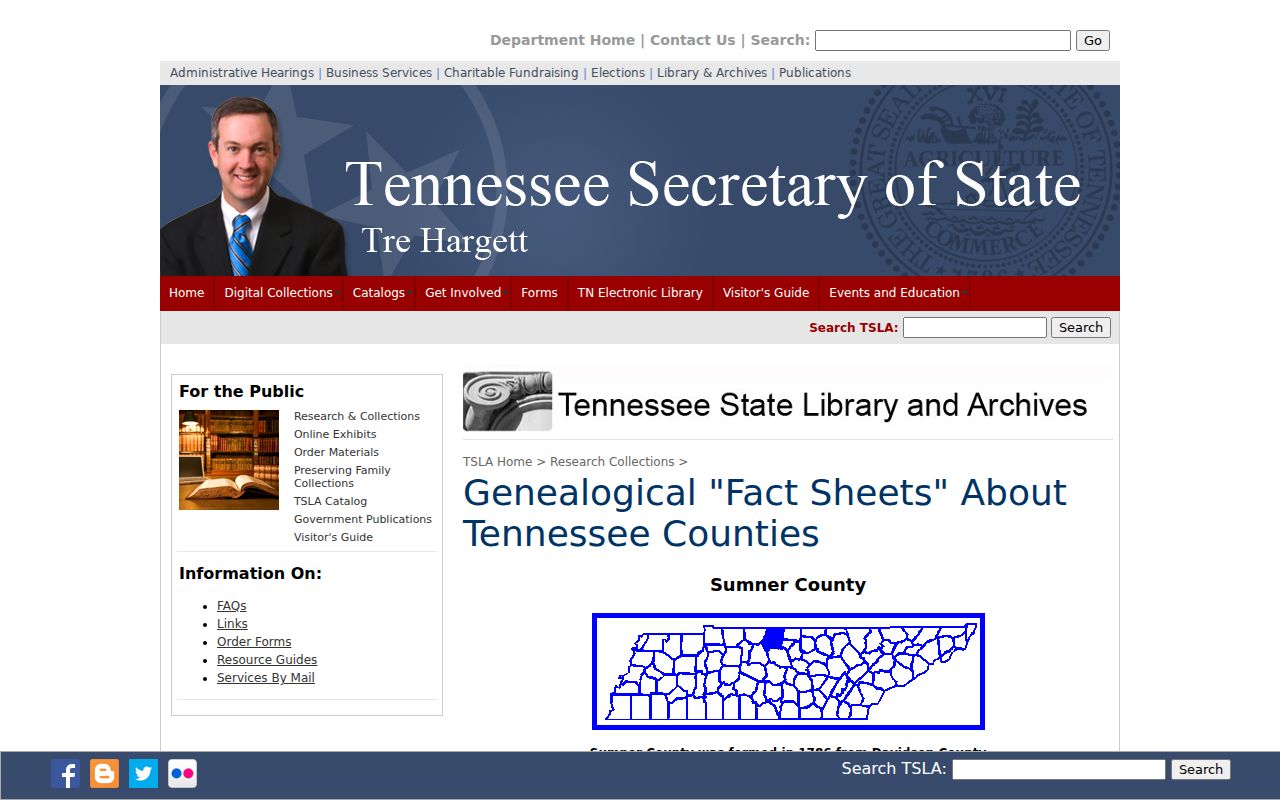
That holdings view is a useful reminder that Gallatin directory work often belongs beside deeds, marriage records, census material, and newspapers, rather than in one all-purpose index.
For the newer period, the same TSLA guide reports a Sumner Polk City Directory run from 2006 through 2014. Treat its name, address, and business information as a lead to compare with the volume itself and contemporary public records.
Note: The research did not establish the first printed Gallatin directory or the last year a local directory was published.
Gallatin History Room Materials
The Bailey History and Genealogical Room at Gallatin Public Library focuses on local, Sumner County, and Tennessee history. Its public branch information does not publish a complete directory inventory, a reverse-directory run, or a database list. That makes a call or email worthwhile before a visit. Ask specifically about Gallatin and Sumner city or telephone directories, criss-cross volumes, newspaper microfilm, obituary indexes, yearbooks, cemetery books, and family files.
The library lists 123 E Main, a phone number of 615-452-1722, and a Tuesday through Saturday schedule, but the research found conflicting ZIP displays for the library. Verify the current mailing address and hours before travel. A staff member may be able to pull a directory volume or say whether a historical database is available at a library workstation.
Gallatin Public Library
Branch information
123 E Main, Gallatin
615-452-1722
Sumner County Archives
Archives holdings
615-452-0037
Reading room and microfilm access
Gallatin Telephone Directory Leads
Gallatin has earlier directory-style leads, but they need careful labels. The Library of Congress telephone-exchange inventory references Gallatin material for 1888 and for 1895 through 1898. These items are not automatically Polk city directories, and the research did not verify online scans or a complete run. They can still help establish a telephone or address lead for a narrow period when paired with a map, deed, tax list, or newspaper.
The Library of Congress telephone-exchange directory guide is the source behind the inventory route shown here.
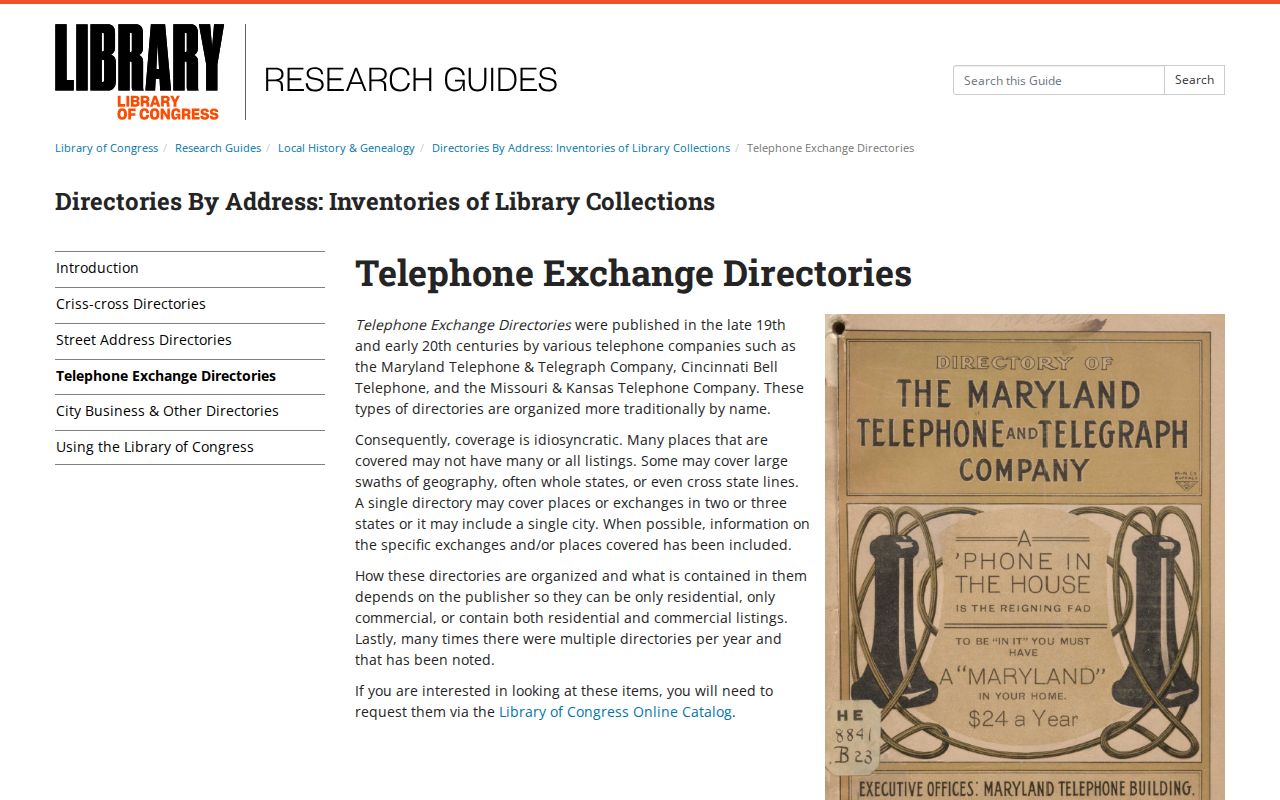
The guide helps distinguish a catalog lead from a digitized record. A Gallatin search should record the stated directory type, location, and year before requesting a volume.
For an address-first search, ask for a Street Address, Criss-Cross, Telephone, or City Business directory by name. The exact Gallatin reverse-directory years were not located, so a name-only book should not be presented as if it can be searched by street.
Reading a Gallatin Directory Entry
No open, page-level image of a Gallatin directory entry was available during the research. For that reason, the items below are an inspection checklist, not a claim that every Gallatin city directory prints every field. Start by photographing or noting the volume's own abbreviation key. Then copy what the page actually says, including initials and punctuation, before turning an abbreviation into a family-history conclusion.
| Printed name | Record the surname, given name, initials, and any spelling variant exactly as printed. |
|---|---|
| Household notation | Note spouse, widow, or other household wording only if the volume displays it. |
| Address | Copy the house number and street, then compare it with the street or reverse section if one exists. |
| Work notation | Preserve an occupation or employer abbreviation without expanding it by guesswork. |
| Ownership marker | Use an owner or renter mark only after confirming its meaning in that volume's key. |
- Criss-cross directory
- An address-ordered directory intended to move from a street address toward an occupant or business listing.
- Householder index
- A name arrangement that may identify the person recorded for a household, if that volume includes one.
- Abbreviation key
- The volume's own legend for shortened words and marks. It should control interpretation of that particular book.
Trace a Gallatin Directory Household
Use a run of Gallatin city directories to test a household over time, not to force one name into every year. Begin with an address from a parcel, deed, map, or family record. When the question is address-to-occupant, request a criss-cross or street directory. When the person is known, use the name arrangement first. Keep old and current street spellings together in the research notes.
- Locate the earliest available listing and copy the name, address, and any stated household wording exactly.
- Check the next documented volume rather than assuming an annual Gallatin publication.
- Compare address changes, initials, spouse notation, and nearby names before deciding that two listings are the same person.
- Pair a directory year with the nearest released federal census or the Archives census indexes to test age, relationship, occupation, and neighborhood.
- Use newspapers, the obituary index, probate, deeds, or a marriage record to test whether a disappearance reflects a move, death, or an unlisted year.
Archives reports federal census microfilm from 1820 through 1930, neighborhood-format census books from 1820 through 1880, and indexes through 1940. The released federal census follows the 72-year rule. A directory can supply an address or occupation, while a census is stronger for household composition and relationships.
Gallatin Archive Indexes by Collection
Sumner County Archives is especially useful when the right Gallatin directory year is absent. The Archives holds deed and deed-index microfilm before 1965, marriage indexes from 1787 through 1995, census material, tax lists, newspapers, maps, family files, a funeral-home collection, and a master obituary index. Its records are largely intact from the county's 1786 formation, but they are distributed across separate collections rather than a universal name search.
Staff can assist in the reading room. The Archives reports no public internet on its computers, no cameras or scanners, and a requirement to secure bags. For remote work, a mail or email request is limited to five items and starts at $20 for up to 30 minutes, with a two-week estimate and 25-cent copies. Name the collection, record type, date range, place, and person or address in the request.
Note: An index miss is not proof that a Gallatin household was absent, because the Archives warns that no universal every-name index exists.
Gallatin Directory Addresses on Maps
A directory address can be checked against the Library of Congress Gallatin Sanborn map collection for January 1888. The four sheets show building footprints, street names, use, material, and fire-risk context. They do not name occupants. Their value is in showing whether an old address or block description makes physical sense before a researcher treats a later directory match as certain.
Historic street names and numbers can change. A map, legal description, plat, or deed may bridge a directory listing to a modern parcel more reliably than a street name alone. This is map context, not proof that a person lived at the location.
Missing Gallatin Directory Years
There is no verified complete publisher sequence for Gallatin, no confirmed first or last printed city-directory year, and no established local reverse-directory run. Online representation is also limited: Tennessee is not broadly represented in the Library of Congress digital telephone-directory collection, and the research did not verify a digitized Gallatin entry. Those gaps call for a catalog check, a Bailey Room question, a TSLA request, or an Archives search rather than a claim that the record does not exist.
When an old address is the real question, the modern parcel and deed chain provide the current-to-earlier framework. The separate Gallatin past residents resource follows that backward address trail without treating a directory shelf as the only source.